
Most business owners know a data breach is expensive. Few know how expensive for their own company. A hospital with 50,000 patient records and a ten-person marketing agency with 2,000 customer emails face very different bills.
Our free data breach cost calculator gives you a realistic estimate in under a minute. Enter a few details, see the projected cost, and download a PDF to share with your leadership team, insurer, or auditor.
Data Breach Cost Calculator
Estimate the financial impact of a data breach for your organization, then download a PDF report.
What Is a Data Breach Cost Calculator?
A data breach cost calculator estimates the total financial impact of a security incident in which personal or confidential data is exposed. Instead of guessing, it combines industry benchmarks with the details of your own organization: how many records you hold, what industry you’re in, how fast you could detect an attack, and how prepared you are.
It’s useful for:
- Budgeting cybersecurity spending against a realistic loss figure
- Insurance planning, to see whether your cyber coverage is enough
- Board and executive reporting, with a PDF you can attach to a risk memo
- Risk assessments and compliance reviews for HIPAA, GLBA, or PCI DSS
How the Data Breach Cost Calculator Works
The tool starts from a benchmark cost per record (about $165) and multiplies it by the number of records you enter. It then adjusts the figure using these factors:
| Input | Why it changes the cost |
|---|---|
| Industry | Healthcare and financial firms face higher costs than most other sectors |
| Records exposed | More records mean more notification, monitoring, and legal work |
| Days to detect and contain | The longer attackers stay inside, the higher the bill |
| Regulated data | HIPAA, GLBA, PCI DSS, and state laws add fines and legal exposure |
| Incident response plan | A tested plan reduces cost; having none increases it |
| Encryption | Encrypted data is less likely to trigger full notification duties |
| Cyber insurance | Subtracted from the total to show your net cost |
The result is split into four categories: detection and escalation, notification, post-breach response, and lost business. These mirror the cost categories used in industry research.
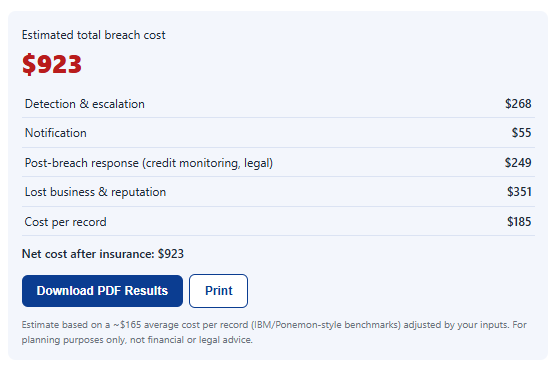
Example: 10,000 Customer Records
A US services company with 10,000 records, regulated data, no incident response plan, no encryption, and a 200-day containment time would see:
- Estimated total: about $2.72 million (roughly $272 per record)
- Detection and escalation: about $790,000
- Notification: about $163,000
- Post-breach response: about $735,000
- Lost business: about $1.03 million
Now change three things: a tested response plan, encrypted data, and the same 200-day timeline. The estimate drops to about $1.58 million, a saving of roughly $1.14 million. That gap is why preparation pays for itself.
How Much Does a Data Breach Cost in the USA?
The most widely cited benchmark is IBM’s annual Cost of a Data Breach Report, based on research by the Ponemon Institute. The 2025 edition found:
- The US average breach cost hit a record $10.22 million, up 9%, while the global average fell 9% to $4.44 million (CyberScoop).
- The US has had the highest breach cost of any country for 15 years running, according to IBM’s report.
- Higher regulatory fines and detection and escalation costs are the main drivers of the US figure.
- Globally, the average cost split was roughly $1.47 million for detection and escalation, $1.38 million for lost business, $1.2 million for post-breach response, and about $390,000 for notification.
Your own number will probably be lower than $10 million if you’re a small or mid-sized business. But averages hide the fact that smaller companies often have less cash and cyber cover to absorb the hit, which is why a company-specific estimate matters.
Data Breach Cost by Industry
Cost varies sharply by sector. IBM’s 2025 research found healthcare was the most expensive industry at $7.42 million on average, and its breaches also took the longest to resolve, at 279 days (reported by HIPAA Journal). Financial services, technology, and energy also sit above the cross-industry average. That’s why the calculator applies an industry multiplier.
What Drives the Cost of a Data Breach?
1. Detection and escalation
Forensic investigations, auditing, crisis management, and communication with leadership. This has been the largest cost category for four years running.
2. Notification
Mailing letters, setting up call centers, emailing customers, and informing regulators. All 50 US states have breach notification laws, and they differ on timing, what data counts, and who must be told. A 50-state survey by Privacy Rights Clearinghouse notes that 24 states give individuals a private right to sue over notification violations (Privacy Rights Clearinghouse).
3. Post-breach response
Credit monitoring, legal fees, help desks, regulatory settlements, and repairing systems.
4. Lost business
Customer churn, downtime, and reputational damage. This often takes months or years to fully show up.
Regulatory Fines: A Big Reason US Costs Are Higher
Fines depend on the data you hold:
- HIPAA: Covered entities must notify affected individuals without unreasonable delay and no later than 60 days after discovering a breach of unsecured health data. Civil penalties are tiered by culpability and can climb past $2 million per violation category for uncorrected willful neglect, with amounts adjusted for inflation each year (HHS Breach Notification Rule).
- State laws: California, New York, Texas, and others set their own deadlines, penalties, and attorney general reporting rules.
- FTC: The Federal Trade Commission can act against businesses that fail to protect consumer data or mislead people about their security.
If you hold regulated data, select “Yes” in the calculator’s regulated data field to reflect this exposure.
How to Lower Your Data Breach Costs
Research points to several practical levers:
- Detect faster. IBM found it took an average of 241 days to identify and contain a breach in 2025, a nine-year low. Every day you cut saves money.
- Use security AI and automation. Teams that used them extensively saved about $1.9 million per breach on average.
- Control shadow AI. Breaches involving unsanctioned AI tools added roughly $670,000 to the cost.
- Have a tested incident response plan. The FTC’s Data Breach Response Guide for Business tells companies to assemble a response team, stop further data loss, preserve forensic evidence, and notify the right parties quickly. It stresses preparing before a breach happens.
- Encrypt sensitive data. It limits what attackers can use and may reduce your legal duties.
- Train employees. IBM found phishing was the most common way in, behind 16% of breaches at an average cost of about $4.8 million.
- Buy the right cyber insurance. Compare your calculated net cost with your policy limits and exclusions.
Why Download the PDF Report?
After you calculate, the PDF gives you a clean summary with your inputs, the total, the cost breakdown, and net cost after insurance. Use it to:
- Support a budget request for security tools or training
- Show insurers or auditors your risk reasoning
- Brief executives or a board without building slides
- Track how your risk changes after you improve your defenses
Limitations of Any Breach Calculator
This tool gives a planning estimate, not a prediction. Real costs depend on the attack type, your contracts, legal outcomes, and customer reaction. Ransomware, insider threats, and multi-cloud environments can raise costs. Use the result alongside a professional risk assessment and advice from legal and insurance experts.
Frequently Asked Questions
How much does the average data breach cost in the USA?
IBM’s 2025 report put the US average at $10.22 million, a record high and more than double the $4.44 million global average.
How do you calculate the cost of a data breach?
Multiply the number of records exposed by the cost per record, then adjust for your industry, regulations, response readiness, encryption, and how long the breach takes to contain. Our calculator does this for you.
What is the cost per record in a data breach?
Benchmarks run at roughly $165 per record on average, but the figure can be far higher or lower. Healthcare records and regulated financial data cost more, and small breaches often carry a higher per-record cost because of fixed legal and forensic fees.
How long do I have to notify customers after a breach?
It depends on the state and on federal rules. Every state requires notice, often “without unreasonable delay,” and some set specific deadlines. HIPAA allows up to 60 days from discovery.
Does cyber insurance cover the full cost of a breach?
Not always. Policies have limits, deductibles, and exclusions. Enter your coverage in the calculator to see your estimated net cost.
Is the data breach cost calculator free?
Yes. Enter your details, review the results, and download your PDF at no charge.
Also see: Free Cybersecurity Risk Score Calculator
Final Thoughts
A data breach can wipe out months or years of profit, and the US is the most expensive place in the world to have one. The sooner you know your own number, the sooner you can decide what to fix. Try the calculator above, download your PDF, and use it to start the conversation about security spending.
Sources
- IBM, Cost of a Data Breach Report 2025
- CyberScoop, IBM Cost of a Data Breach 2025 coverage
- U.S. Federal Trade Commission, Data Breach Response: A Guide for Business
- U.S. Department of Health & Human Services, HIPAA Breach Notification Rule
- Privacy Rights Clearinghouse, Data Breach Notification Laws: A 50-State Survey (2026)
- HIPAA Journal, Average Cost of a Healthcare Data Breach 2025